From the blog
Decoding Your Insurance Adjuster's Report for Roof Damage in Nashville, TN
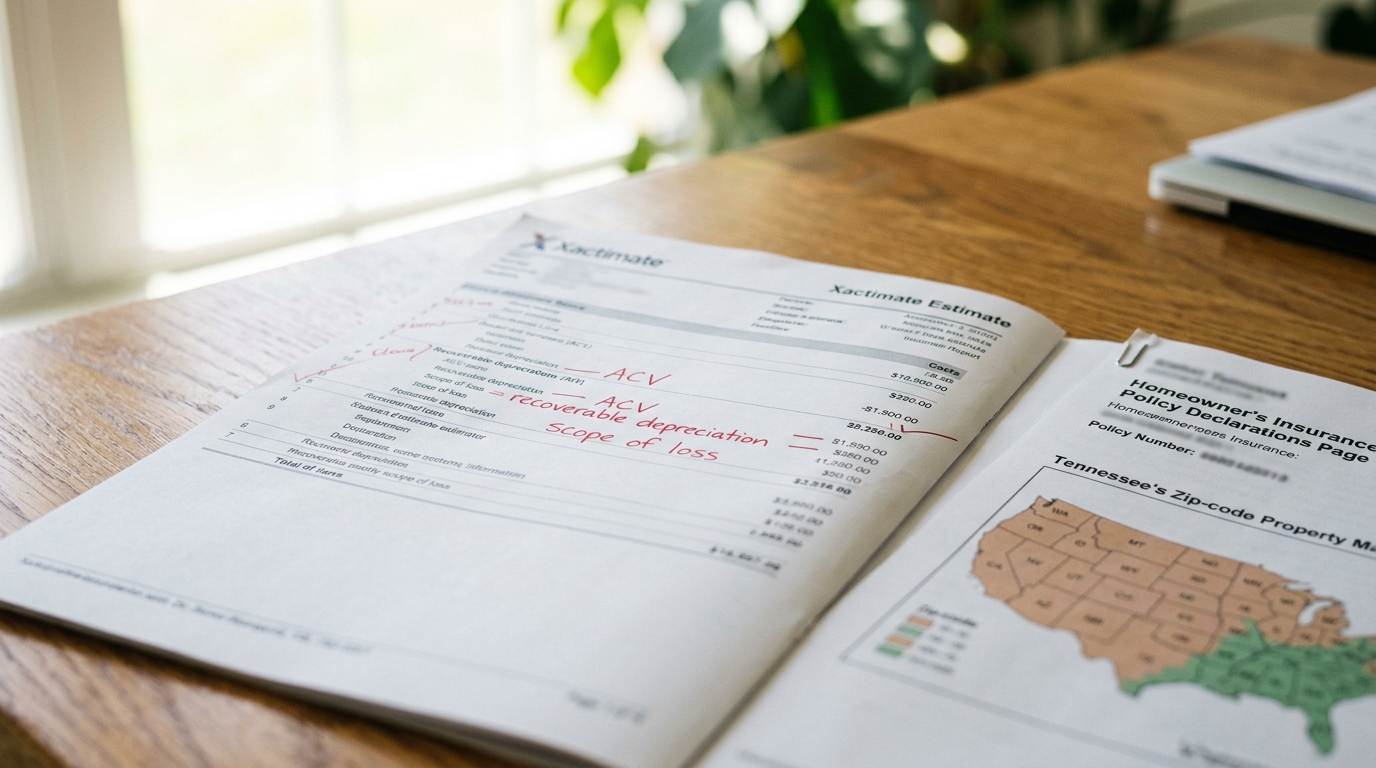
What Your Insurance Adjuster's Report Actually Means for Your Nashville Roof Claim
An insurance adjuster's report determines how much money you receive to repair or replace your storm-damaged roof. Understanding every line item in that document, from the scope of loss to the depreciation schedule, is the single most important step Middle Tennessee homeowners can take to avoid leaving thousands of dollars on the table after a hail or wind event.
Nashville, Franklin, Brentwood, Murfreesboro, and Hendersonville all sit in a severe weather corridor that produces damaging hail and straight-line wind several times a year. When a storm hits, insurers dispatch adjusters quickly, and the report they generate becomes the financial baseline for your entire claim. Knowing how to read it, and how to push back when it is wrong, puts you in control of the outcome.
How the Roof Insurance Claim Process Works in Tennessee
Tennessee follows a standard property insurance claim timeline, but the specifics matter. After a storm, you typically have one year from the date of loss to file a claim under most Tennessee homeowner policies, though some carriers have tightened that window to 180 days. Read your declarations page before assuming you have time to wait.
Once you file, the carrier assigns an adjuster, either a staff adjuster employed by the insurer or an independent adjuster contracted for high-volume storm events. The adjuster inspects the property, documents the damage, and produces a report using estimating software, most commonly Xactimate, the industry standard. That report assigns a line-item cost to every repair or replacement task the adjuster believes is necessary.
The report then separates your settlement into two numbers:
- Actual Cash Value (ACV): The replacement cost of the damaged materials minus depreciation. This is the check you receive first.
- Recoverable Depreciation: The withheld portion released after you complete repairs and submit a final invoice, assuming your policy includes replacement cost value (RCV) coverage.
If your policy only covers ACV, depreciation is never recovered. Many homeowners in Murfreesboro and Franklin discover this gap only after they open the first check and realize it does not cover the full cost of a new roof. Confirm your coverage type before the adjuster arrives.
Breaking Down the Adjuster's Report Line by Line
Xactimate reports follow a consistent structure. Here is what each major section means and where errors are most common on storm damage roof repair claims in Nashville and surrounding counties.
Scope of Loss: This section lists every damaged component the adjuster identified: shingles, underlayment, ice and water shield, ridge cap, drip edge, flashing, gutters, and ventilation. Missing line items are the most common problem. If an adjuster documents shingle damage but omits drip edge replacement, you may be responsible for a gap that a contractor cannot legally skip during installation.
Quantities: Roofing is measured in squares (one square equals 100 square feet). Verify that the square count in the report matches your actual roof area. Adjusters using satellite measurements sometimes under-count on complex roofs with multiple valleys, dormers, or steep pitches, which are common in Brentwood and Hendersonville neighborhoods built in the 1990s and 2000s.
Unit Pricing: Xactimate prices update regionally on a rolling basis. If the adjuster used a price database that lags current material costs, the per-square rate for shingles may be insufficient to cover what a licensed contractor actually charges in Middle Tennessee today. In 2025, regional roofing material costs rose measurably due to supply chain adjustments, and some Xactimate regional files did not reflect those increases immediately.
Overhead and Profit (O&P): When a general contractor coordinates a roofing project, insurers are required to include a standard overhead and profit markup, typically 10% overhead and 10% profit. Adjusters sometimes omit O&P on straightforward roofing jobs. If you are working with a roofing company that handles project management beyond simple installation, that markup is legitimate and recoverable.
Depreciation Schedule: Age and condition are used to calculate how much value is withheld from your first check. A 15-year-old asphalt shingle roof will carry significant depreciation. Review the depreciation percentage applied to each material. If the adjuster aged your roof beyond its actual installation date, that error inflates the withheld amount.
Identifying Hail and Wind Damage the Adjuster May Have Missed
Adjusters complete dozens of inspections per week during a storm event. Damage is sometimes overlooked, particularly on low-slope sections, valley areas, or the north-facing slopes that receive less direct sunlight and are harder to inspect from a ladder position.
For hail damage roof claims in Franklin, TN and across Middle Tennessee, look for these signs that should appear in any complete report:
- Granule loss in a random, splatter pattern distinct from normal wear
- Soft spots or bruising on shingles visible when pressing lightly with a thumb
- Dents on aluminum flashing, ridge vents, or gutters, which confirm hail size and trajectory
- Impact marks on HVAC curbs or pipe boots
- Cracked or split shingles along the rake edges from wind uplift
Wind damage in Murfreesboro often presents differently than hail. Look for lifted tab edges, missing shingles on the windward slope, and broken seals along the roof perimeter. If the adjuster documented damage on only one slope, request a supplemental inspection. Wind damage is frequently asymmetrical, but full perimeter exposure matters for a complete wind damage roof claim.
When to Request a Supplement or Dispute the Report
A supplement is an additional claim submitted after the initial report to account for items the adjuster missed or underpriced. Supplements are routine in the roofing industry. Requesting one does not constitute bad faith on your part and rarely delays a claim significantly.
Common grounds for a supplement on Nashville storm damage claims include:
- Missing line items such as ice and water shield, code-required underlayment upgrades, or permit fees
- Incorrect square footage
- Pricing below current local market rates
- Omitted O&P when coordination work is involved
- Damage to gutters, downspouts, or fascia documented during contractor inspection but absent from the adjuster's report
If the carrier denies your supplement or disputes the scope of damage, Tennessee law allows you to invoke the appraisal clause found in most standard homeowner policies. Under appraisal, each party hires an independent appraiser, and a neutral umpire resolves disagreements. This process bypasses litigation and typically resolves within 60–90 days.
For disputes involving significant dollar amounts, a licensed public adjuster can advocate on your behalf, though they charge a percentage of the settled claim amount, typically 10–15%. Weigh that fee against the gap between the initial offer and what a licensed roofing contractor says the work actually costs.
Working With a Roofing Contractor During the Claims Process
The most effective approach for filing a roof claim in Tennessee is to involve a qualified roofing contractor before the adjuster arrives, or immediately after the initial inspection if the report comes back short.
A GAF Master Elite certified contractor brings specific advantages in this context. The certification requires documented installation quality standards, ongoing training, and the ability to offer the GAF Golden Pledge warranty, a lifetime workmanship warranty backed by GAF directly rather than solely by the contractor. That warranty is meaningful documentation of installation quality, which strengthens your position if a carrier later questions whether a repair was performed to manufacturer standards.
A qualified contractor can also provide a detailed written estimate using the same Xactimate framework adjusters use, making line-by-line comparison straightforward. Contractors experienced with the storm damage roof repair process in Nashville know which line items are routinely omitted and can build a complete supplement package that includes photographs, measurements, and material specifications.
Avoid any contractor who asks you to sign an Assignment of Benefits (AOB) agreement that transfers your claim rights to the company. Tennessee has restrictions around AOB agreements in property claims, and signing one removes your ability to negotiate or dispute the settlement directly.
Roof Insurance Claim FAQ for Middle Tennessee Homeowners
How long does a roof insurance claim take in Tennessee?
Tennessee law requires insurers to acknowledge a claim within 10 days and make a coverage determination within 15 business days after receiving all required documentation. Most straightforward hail or wind claims settle within 30–45 days. Claims requiring supplements or appraisal can extend to 90 days or longer.
Can I choose my own roofing contractor for an insurance claim repair?
Yes. Tennessee law does not require you to use a contractor selected or preferred by your insurance company. You have the right to hire any licensed roofing contractor you choose. The insurer pays based on the agreed scope and pricing, not on which company performs the work.
What is the difference between ACV and RCV coverage for roof claims?
Actual Cash Value (ACV) coverage pays replacement cost minus depreciation, and that depreciation is never returned. Replacement Cost Value (RCV) coverage pays ACV first, then releases the withheld depreciation after repairs are completed and documented. For a 15-year-old roof, the difference between ACV and RCV settlements can exceed $4,000–$8,000 on a typical Middle Tennessee home.
What if my adjuster says the damage is below my deductible?
Request the full written report and have a licensed roofing contractor complete an independent inspection before accepting that conclusion. Adjusters working high-volume storm events sometimes undercount damage on complex roofs. A detailed contractor estimate may identify a higher scope of loss that clears your deductible threshold. Never pay a contractor who offers to waive your deductible; that practice is insurance fraud under Tennessee law.
Does filing a roof claim raise my homeowner's insurance premium in Tennessee?
Filing a weather-related claim, classified as a non-fault loss, has less impact on premiums than an at-fault claim such as fire caused by negligence. However, multiple claims within a short window can affect your renewal terms. Discuss the likely premium impact with your agent before filing if the damage amount is close to your deductible, to determine whether paying out of pocket makes financial sense.
