From the blog
Drone Inspection vs. Traditional Inspection: Why Middle TN Weather Demands Modern Methods
Drone Roof Inspection vs. Traditional Inspection: Why Middle Tennessee Weather Demands Modern Methods
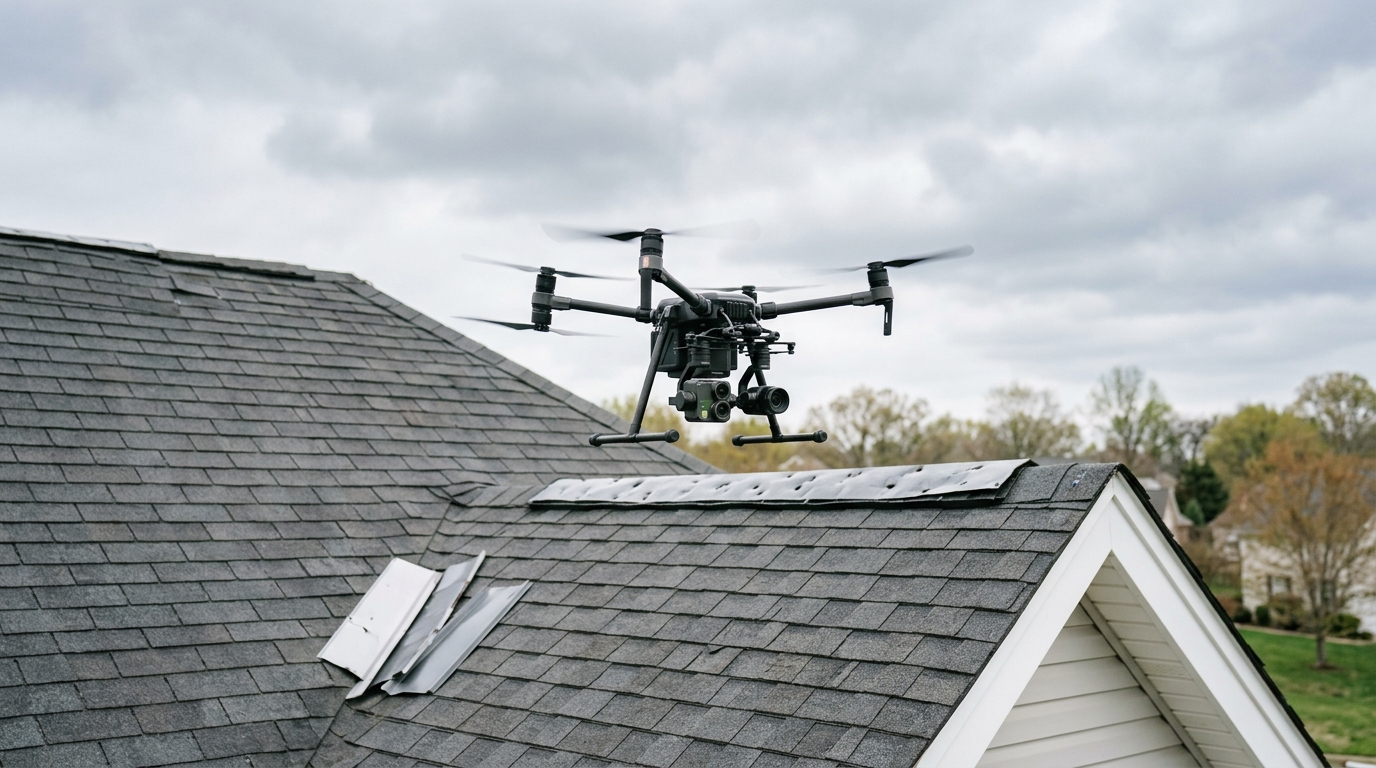
A drone roof inspection documents damage across every roof plane in 15–20 minutes, producing high-resolution imagery and thermal data that a physical ladder-and-boots inspection routinely misses. For homeowners in Franklin, Murfreesboro, Nashville, and surrounding Middle Tennessee, where severe hail and wind events strike multiple times per year, that precision gap between the two methods directly affects how much your insurance claim pays out.
Why Middle Tennessee's Weather Makes Roof Inspection Unusually Difficult
Middle Tennessee sits at the convergence of Gulf moisture and cold continental air, making it one of the most active severe-weather corridors in the country. A 2024 NOAA Storm Data report documented more than 140 significant hail and wind events across the Nashville metro and surrounding counties in a single calendar year. That frequency creates a specific inspection problem: damage from consecutive storms overlaps, making it hard to determine which event caused which failure point.
Traditional inspections rely on an inspector physically walking the roof, which introduces two compounding limitations. First, steep-pitch roofs common in Middle Tennessee's residential architecture, many exceeding 8:12 and 10:12 pitches, create genuine fall-risk conditions that cause inspectors to spend less time on the most vulnerable areas, particularly ridgelines and valleys. Second, the human eye at close range struggles to see the directional patterning of hail impact bruising, which shows up clearly in overhead imagery but is nearly invisible when you are standing directly on the damaged shingle.
What a Drone Roof Inspection Actually Shows
Drone inspection platforms capture data that a ground-level or physical inspection cannot replicate. Here is what high-quality drone inspection equipment documents on a Middle Tennessee residential roof:
- Hail impact patterns: Overhead 4K imagery reveals the directional scatter of hail strikes, confirming wind direction and storm origin. Insurance adjusters use this to validate claims against National Weather Service storm path data.
- Granule loss mapping: Consistent granule loss from aging looks different from impact-specific granule displacement. Drone imagery distinguishes the two, which matters when an insurer questions whether damage is storm-related or wear-related.
- Flashing separation and lifted edges: Camera angles at varying altitudes show flashing pull-away at chimneys, skylights, and pipe boots, conditions that often cause interior leaks before they are visible from inside the attic.
- Valley deterioration: Roof valleys concentrate water flow and deteriorate faster than field shingles. Angled drone passes document valley condition with detail that would require a ladder repositioned multiple times during a traditional inspection.
- Ridge cap integrity: Wind damage commonly begins at ridge caps. An overhead pass documents missing, lifted, or cracked ridge caps across the full length of every ridgeline in a single image set.
- Gutter damage and debris accumulation: Drone imagery confirms hail-dented gutters and downspouts alongside roof damage, supporting a bundled claim for both systems.
Drone Inspection vs. Traditional Inspection: A Direct Comparison
| Factor | Traditional Physical Inspection | Drone Inspection |
|---|---|---|
| Time on roof | 30–90 minutes depending on pitch and size | 15–20 minutes total flight time |
| Safety risk | High on steep-pitch or wet roofs | No inspector on roof surface |
| Documentation output | Photos from select vantage points | Hundreds of georeferenced images, video, optional thermal overlay |
| Hail impact visibility | Good at surface level, poor for pattern mapping | Excellent for directional pattern and density mapping |
| Insurance adjuster usability | Moderate, requires adjuster to re-inspect | High, image sets submitted directly with claim documentation |
| Ability to cover full roof | Limited by pitch, weather, and inspector mobility | Full perimeter and overhead coverage regardless of pitch |
| Cost to homeowner | Varies by contractor, often included in estimate | Free with most reputable roofing companies in Middle TN |
Ironclad's 21-Point Roof Inspection: What Each Step Covers
A 21-point roof inspection is a structured checklist protocol that ensures no component is overlooked during the assessment. Ironclad Roofing's 21-point inspection divides the roof system into logical zones and evaluates each one independently, rather than relying on a general visual sweep. Here is how the major zones break down:
- Field shingles (4 points): Granule loss, impact bruising, cracking, and curling across all roof planes.
- Ridge and hip caps (2 points): Fastener pull-through and cap displacement from wind uplift.
- Valleys (2 points): Metal or closed-cut valley condition and any exposed underlayment.
- Flashings (4 points): Step flashing at walls, counter flashing at chimneys, pipe boot seals, and skylight perimeters.
- Gutters and downspouts (3 points): Hail denting, fascia attachment, and downspout diverter function.
- Soffit and fascia (2 points): Wind-driven moisture intrusion and paint or material delamination.
- Attic interior (2 points): Ventilation adequacy and moisture staining on decking or rafters confirming active leak paths.
- Structural (2 points): Visible deck deflection and rafter alignment visible from drone imagery and attic access.
Each point generates a specific notation in the inspection report that corresponds to a numbered photograph from the drone image set. This one-to-one match between written finding and visual evidence is what makes the report usable by a homeowner filing an insurance claim without needing a second adjuster visit.
Free Drone Roof Inspections in Murfreesboro and Franklin, TN
Ironclad Roofing offers no-cost drone inspections throughout Middle Tennessee, including Murfreesboro, Franklin, Brentwood, Hendersonville, and the greater Nashville area. There is no obligation to purchase a replacement or repair, and the inspection report belongs to the homeowner regardless of the outcome.
For homeowners who recently experienced a storm event, scheduling promptly matters for two specific reasons. First, Tennessee's statute of limitations for filing a property insurance claim runs from the date of loss, not the date of discovery, so delayed inspections compress your timeline. Second, if a second storm system passes through before you document the first event's damage, an insurer may argue that distinguishing between the two is impossible and deny a portion of the claim.
The inspection itself takes under an hour from arrival to written report delivery. A licensed Ironclad technician operates the drone while a separate roofing consultant reviews the live footage and identifies areas requiring closer documentation. After the flight, the image set is processed and delivered alongside the completed 21-point checklist, which you can submit directly to your insurance carrier or use as a baseline assessment if no damage is found.
When Traditional Methods Still Have a Role
Drone inspection does not eliminate every use case for physical roof access. When preliminary imagery identifies specific anomalies such as a separated flashing collar or a suspicious soft spot in the decking, a targeted physical inspection of that area provides confirmation that camera resolution cannot fully replace. Ironclad's process uses the drone data to direct physical attention precisely, rather than requiring an inspector to walk the entire roof surface on speculation.
Thermal imaging adds a third layer in cases where interior water staining suggests an active leak but the drone's visible-light imagery does not show an obvious entry point. Thermal overlays detect moisture trapped in roofing assemblies by identifying temperature differentials, a method that a physical inspection cannot replicate at all.
Drone Roof Inspection FAQ for Middle Tennessee Homeowners
What does a drone roof inspection show that a traditional inspection misses?
Drone inspections produce overhead imagery that maps the directional pattern and density of hail impacts across every roof plane simultaneously. A traditional inspection captures close-up surface detail but cannot show the spatial relationship between strike points, which is the data insurance adjusters use to correlate damage with a specific storm event from NWS records.
Is a free drone roof inspection in Murfreesboro or Franklin, TN actually free?
Yes. Ironclad Roofing provides no-cost drone inspections throughout Middle Tennessee with no purchase obligation. The completed 21-point report and image set belong to the homeowner and can be submitted to any insurance carrier or used for a second opinion from another contractor.
How long does a drone roof inspection take?
The drone flight itself takes 15–20 minutes for a standard residential property. Including arrival, equipment setup, image processing, and report walkthrough with the homeowner, most inspections are complete within 45–60 minutes.
Can I use a drone inspection report to file an insurance claim?
Yes. The georeferenced image set and 21-point inspection report generated by Ironclad's process are formatted to support insurance claim documentation. Many insurance carriers accept this documentation in lieu of, or alongside, their own adjuster's inspection, reducing the time required to process and approve a claim.
How soon after a storm should I schedule a drone roof inspection?
Schedule within 30 days of any significant hail or wind event. Tennessee insurance claim filing windows run from the date of loss, and documenting damage before a subsequent storm passes through prevents an insurer from commingling damage from two separate events, which commonly results in partial claim denials.
