From the blog
K-Style vs. Half-Round Gutters: Choosing the Right Profile for Your Tennessee Home
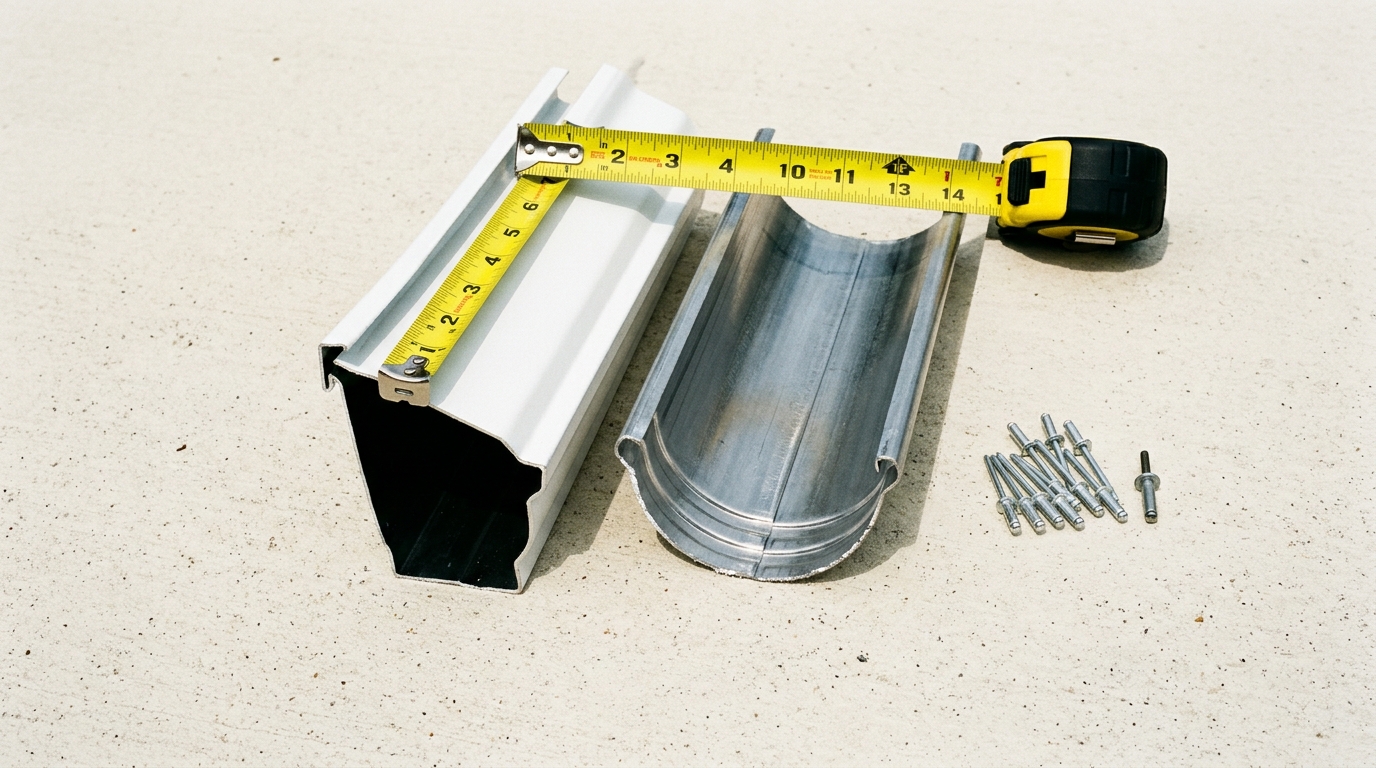
K-style gutters are the better choice for most Middle Tennessee homes. They carry more water per linear foot, cost less to install, and suit the architecture of most houses built since the 1960s. Half-round gutters make sense on historic homes, copper-accented designs, and some Craftsman or Victorian exteriors. Pairing either profile with a seamless installation during a roof replacement saves labor and protects your new shingles.
K-Style vs. Half-Round Gutters: 6 Key Differences
| Factor | K-Style | Half-Round |
|---|---|---|
| Shape | Flat back, flat bottom, decorative front resembling crown molding | Semicircular trough, open at the top |
| Capacity (5-inch size) | About 20–30% more water than a same-width half-round | Lower volume per inch of width |
| Typical installed cost in Nashville area | $8–$15 per linear foot for aluminum | $12–$25+ per linear foot for aluminum, more for copper |
| Best architectural fit | Ranch, traditional, colonial, new construction | Historic, Victorian, Craftsman, European-style |
| Debris behavior | Corners can trap leaves and silt | Smooth interior self-cleans more easily |
| Hanger and fascia needs | Mounts flush to a flat fascia board | Uses exposed strap or bracket hangers, often on a curved or decorative fascia |
How Each Profile Handles Middle Tennessee Rainfall
Nashville averages roughly 50 inches of rain a year, and spring thunderstorms regularly deliver more than an inch of rain in under an hour. Gutter capacity matters more here than in drier regions. A standard 5-inch K-style gutter handles the roof runoff for most single-story and two-story homes with typical pitches. A 6-inch K-style is the right upgrade for steep roofs, large roof planes, or valleys that funnel water into a single run.
Half-round gutters carry less water for their width. A 5-inch half-round on a large, steeply pitched roof can overshoot during heavy downpours, sending water over the front edge and onto landscaping or foundation soil. If you want half-round on a larger home, plan for a 6-inch size and add extra downspouts. A common rule is one downspout per 30–40 feet of gutter run for K-style, and closer to one per 25–30 feet for half-round.
Pitch matters too. Roof pitch determines how fast water arrives at the gutter. Steeper roofs, common on Franklin and Brentwood custom homes, push water off with more velocity, so it can shoot past the gutter lip. A drip edge and correctly set gutter angle prevent that, and your roofer should install both as part of the roof replacement.
Seamless vs. Sectional Gutters
The profile decision is separate from the seamless decision. Both K-style and half-round come in seamless and sectional versions, and seamless is the better choice on nearly every Tennessee home.
- Seam count: Sectional gutters come in 10-foot pieces joined every 10 feet. Seamless gutters are roll-formed on site from a single coil, so the only seams are at corners and downspout outlets.
- Leak risk: Every sectional joint is sealed with caulk that dries, cracks, and fails after several years of Tennessee heat and freeze cycles. Fewer joints mean fewer leak points.
- Cost: Sectional material is cheaper, and DIY kits are available at home centers. Seamless costs more per foot but typically requires less maintenance over its life.
- Lifespan: Seamless aluminum commonly lasts 20–30 years. Sectional systems often need reseaming or replacement sooner.
- Installation: Seamless requires a roll-forming machine and a trained crew. Sectional can be assembled by a homeowner, but alignment and pitch errors are common.
For homes in Nashville, Franklin, Brentwood, Murfreesboro, and Hendersonville, seamless K-style aluminum is the default recommendation. It offers the best balance of capacity, cost, and durability.
Gutter Materials Compared
| Material | Typical Lifespan | Relative Cost | Best Use |
|---|---|---|---|
| .027 aluminum | 20–30 years | Low | Standard residential, builder-grade |
| .032 aluminum | 25–35 years | Moderate | Heavier-duty upgrade, resists denting from ladders and limbs |
| Galvalume steel | 20–30 years | Moderate | High-wind or high-impact areas, rust risk if coating is scratched |
| Copper | 50+ years | Very high | Historic and high-end architectural homes |
Aluminum is the practical choice for most Middle Tennessee homeowners. It does not rust, accepts factory-baked paint in dozens of colors, and weighs less than steel, which reduces stress on fascia boards. Choosing .032 over .027 adds a modest amount to the quote and adds real resistance to dents from hail and fallen limbs.
Gutter Installation Cost in Nashville
Gutter installation cost in Nashville depends on profile, material, home size, and the number of stories. For a typical 2,000-square-foot home with roughly 150–200 linear feet of gutter, expect these ranges for 2026:
- Seamless 5-inch K-style aluminum: about $1,500–$3,000 installed
- Seamless 6-inch K-style aluminum: about $2,000–$3,800 installed
- Half-round aluminum: about $2,500–$5,000 installed
- Copper half-round: often $6,000–$12,000 or more
Costs rise with second-story runs, complex rooflines with many corners, and extra downspouts. Each corner adds labor and a sealed miter joint, so a cut-up roof with 12 corners costs more than a simple rectangle of the same length. Ask for an itemized quote listing linear footage, gauge, downspout count, and any gutter guards, so you can compare bids accurately.
Why Install Gutters During a Roof Replacement
Gutters attach to the fascia, which sits directly under the roof edge. Replacing the roof first exposes the fascia and drip edge, so any rot gets found and fixed before new gutters go on. Installing gutters afterward avoids the risk of ladders and crews damaging fresh shingles and gives you a single warranty conversation with one contractor.
Coordination also protects your shingle warranty. Water that overshoots or backs up behind a poorly pitched gutter can soak the roof deck edge and rot the fascia. A GAF Master Elite contractor installs the drip edge and starter strip so that water flows into the gutter instead of behind it. If your project is tied to an insurance claim, ask the adjuster whether gutter replacement is included in the scope. Hail and wind that damage shingles often dent gutters too, and gutter damage is frequently covered under the same claim.
How to Choose: A Decision Checklist
- Check your fascia. Flat fascia suits K-style. Rounded or decorative fascia suits half-round.
- Measure roof area and pitch. Large or steep roofs need 6-inch gutters and extra downspouts.
- Look at your trees. Heavy oak, maple, or sweetgum coverage favors a gutter guard system and an easy-to-clean profile.
- Match the home's style. Use half-round only when it fits the architecture or historic district guidelines.
- Set a budget by linear foot. Compare bids using price per foot, gauge, and downspout count.
- Bundle with the roof. Schedule gutters right after shingles are installed.
Seamless Gutter and Profile FAQ
Are K-style gutters better than half-round gutters?
K-style gutters are better for most homes because they hold more water, cost less, and mount easily to standard flat fascia. Half-round gutters are better for historic or European-style homes where appearance is the priority.
How much do seamless gutters cost in Nashville?
Seamless aluminum K-style gutters typically cost $8–$15 per linear foot installed in the Nashville area in 2026. A typical home runs $1,500–$3,000, with higher totals for two-story homes, complex rooflines, or 6-inch sizes.
What is the difference between seamless and sectional gutters?
Seamless gutters are formed from a single continuous piece on site, so seams only appear at corners and outlets. Sectional gutters are joined every 10 feet with sealed connections that are the most common source of leaks.
Should I replace gutters when I replace my roof?
Yes. The fascia and drip edge are exposed during roof replacement, so repairs are simple and new gutters can be pitched correctly. It also prevents ladder damage to new shingles.
What size gutter do I need in Middle Tennessee?
5-inch K-style gutters work for most homes with moderate roof areas. Choose 6-inch gutters for steep roofs, large roof planes, or homes where heavy spring storms overflow existing 5-inch gutters.
