From the blog
The Ultimate Guide to Navigating a Tornado Damage Roof Claim in Murfreesboro, TN
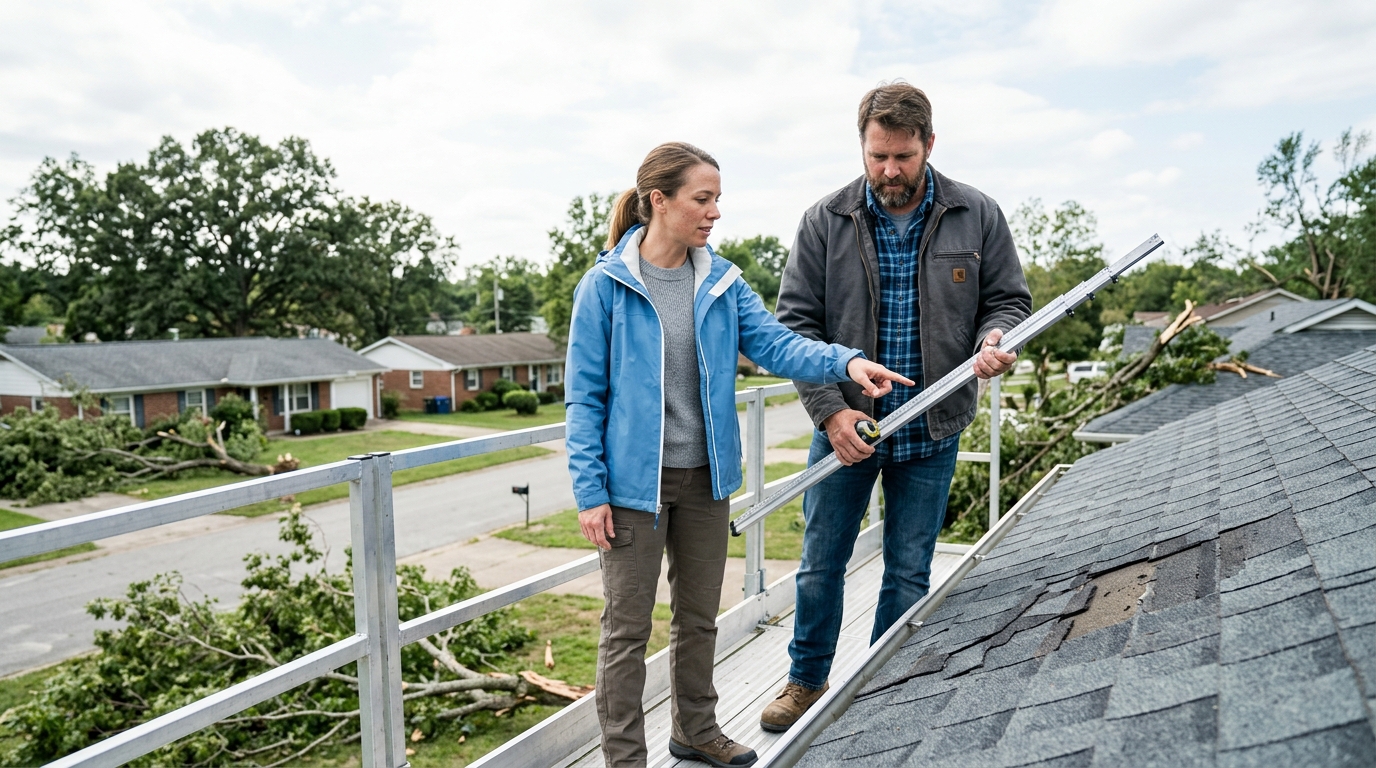
Filing a Tornado Damage Roof Claim in Murfreesboro: The Fast Answer
A tornado damage roof claim in Murfreesboro, TN follows a five-step process: document the damage with photos, request a free professional roof inspection within 24-48 hours, file the claim directly with your carrier, meet the adjuster on-site with your contractor present, and get a written scope of work before any repair or replacement begins. Tennessee homeowners policies generally cover wind and hail damage to roofing systems, but claim approval depends on documentation quality and timing.
Middle Tennessee sits squarely in a tornado-prone corridor, and Rutherford County has recorded multiple EF-1 through EF-3 tornado events in recent years. When a storm rips through Murfreesboro, Smyrna, or La Vergne, roof damage is often the most expensive and least visible casualty. This guide walks through exactly what to do, in what order, and why each step protects your claim.
Identifying Tornado and Wind Damage on Your Roof
Tornado damage doesn't always look dramatic. Missing shingles are obvious, but the claims that get denied are usually the ones where homeowners miss the subtler signs until a leak shows up months later. Look for these indicators after any storm with winds above 50 mph:
- Creased or lifted shingles: Wind gets underneath the shingle tab and creases the mat, breaking the seal even if the shingle doesn't blow off.
- Granule loss in gutters: A heavy accumulation of asphalt granules in downspouts or at the base of gutters signals impact damage from hail or wind-driven debris.
- Exposed or torn underlayment: Visible felt paper or synthetic underlayment means the shingle layer above it is compromised.
- Displaced ridge caps and flashing: High winds concentrate force at roof edges, ridges, and valleys first.
- Debris impact marks: Tree limbs, fence panels, and airborne construction debris common in tornado events leave dented or punctured roofing.
Because many of these signs are invisible from the ground, a drone roof inspection is the safest and most accurate way to document damage immediately after a storm, without anyone climbing onto a potentially compromised roof deck.
The Tennessee Roof Insurance Claim Process, Step by Step
Tennessee does not impose a statewide deadline for filing a wind or hail claim, but most carrier policies specify a window, often one year from the date of loss, to report damage. Waiting longer than necessary weakens your position and increases the risk that an adjuster attributes damage to age or neglect rather than the storm event.
- Document immediately. Take dated photos and, if safe, video of visible damage from the ground. Note the date and approximate time of the storm.
- Schedule a professional inspection within 24-48 hours. A licensed roofing contractor can identify damage an untrained eye will miss and provide a written inspection report that becomes part of your claim file.
- File the claim with your carrier. Most Tennessee insurers, including State Farm, Farmers, Allstate, and Nationwide, accept claims by phone or through an online portal. Have your policy number, date of loss, and inspection report ready.
- Meet the insurance adjuster on-site. Request that your contractor attend this appointment. A contractor who regularly works with Tennessee adjusters can point out damage the adjuster's initial walkthrough might miss.
- Review the adjuster's scope and estimate. Compare it line-by-line against your contractor's inspection report before signing anything or accepting a settlement check.
- Negotiate discrepancies. If the carrier's scope omits damaged flashing, gutters, or decking, your contractor can submit a supplemental estimate with photo evidence.
Wind vs. Hail Damage Claims: Key Differences
Insurance adjusters evaluate wind and hail damage differently, and understanding the distinction helps you anticipate how your claim will be scored.
| Factor | Wind Damage Claims | Hail Damage Claims |
|---|---|---|
| Primary evidence | Lifted, creased, or missing shingles; exposed underlayment | Circular bruising, granule loss, soft-spot indentations |
| Typical adjuster tool | Visual inspection, wind-speed data from NOAA reports | Chalk test, granule count, mat exposure check |
| Common denial reason | Damage attributed to pre-existing wear or improper installation | Bruising deemed cosmetic and non-functional |
| Best supporting documentation | Drone imagery showing uplift patterns across slopes | Close-up macro photos with a test square measurement |
| Coverage likelihood in Middle TN | High, if winds exceeded 50-60 mph per local storm reports | Moderate to high, depends heavily on shingle age and type |
Hail damage claims are more frequently disputed because carriers can argue the damage is cosmetic rather than functional. This is why working with a GAF Master Elite certified installer matters: these contractors are trained to document damage in the format insurance adjusters expect, reducing back-and-forth disputes.
Why GAF Master Elite Certification Matters for Your Claim
Fewer than 3% of roofing contractors nationwide hold GAF Master Elite status, GAF's highest certification tier. For Middle Tennessee homeowners filing storm claims, this distinction has practical consequences beyond installation quality:
- Manufacturer-backed warranties. Master Elite contractors can offer GAF's Golden Pledge warranty, which covers both materials and workmanship for up to 25 years, a level of protection non-certified installers cannot extend.
- Insurance-familiar documentation. These contractors routinely produce inspection reports formatted the way adjusters expect, which speeds up claim approval.
- Code compliance knowledge. Master Elite installers stay current on Rutherford County and City of Murfreesboro building code requirements, which matters when a full tear-off triggers new permitting rules.
- Accountability. GAF can revoke certification for poor workmanship, giving homeowners a layer of oversight beyond a standard contractor license.
Repair vs. Full Replacement: What Determines the Outcome
Not every tornado-damaged roof requires full replacement, but insurance carriers and contractors sometimes disagree on where the line falls. Three factors typically decide it:
- Extent of coverage area. If damage affects more than roughly 30% of a single roofing plane, most carriers and manufacturers require full replacement of that slope rather than a patch repair, since spot repairs on an older shingle can't reliably match granule wear and seal integrity.
- Shingle discontinuation. If your current shingle profile or color has been discontinued, insurers in Tennessee generally approve full replacement because an exact match isn't available.
- Structural exposure. Any sign of decking rot, compromised trusses, or water intrusion into the attic pushes the claim toward full replacement regardless of the percentage of visible shingle damage.
A licensed contractor's written inspection report should state explicitly whether repair is code-compliant and structurally sound, or whether replacement is the only durable option. This report becomes critical evidence if your claim is underpaid or denied.
Preventing Future Storm Damage in Middle Tennessee
Once repairs or replacement are complete, a few upgrades reduce the odds of repeat damage during the next severe weather season:
- Impact-resistant shingles (Class 4 rating): These reduce hail-related granule loss and cracking, and many Tennessee insurers offer a premium discount for installing them.
- Enhanced nailing patterns: Six-nail installation instead of the standard four-nail pattern significantly improves wind uplift resistance in the 90-110 mph range common during tornado outbreaks.
- Seamless gutters: Traditional sectional gutters pull away from fascia boards during high wind events. Seamless aluminum gutters, custom-formed on-site, have fewer joints and hold up better against wind-driven debris common in Middle Tennessee storms.
- Trimmed tree canopy: Limbs overhanging the roofline are the single most common source of impact damage during straight-line wind and tornado events in Nashville, Franklin, and Brentwood neighborhoods with mature tree cover.
Working With Your Contractor Through the Claims Timeline
A reputable contractor does more than install shingles, they act as your advocate through the insurance process. Expect a qualified Middle Tennessee roofer to:
- Attend the adjuster meeting and provide a competing scope of work if the carrier's estimate is incomplete.
- Explain your policy's depreciation holdback, so you understand when the final payment (recoverable depreciation) is released after project completion.
- Provide a lifetime workmanship warranty separate from the manufacturer's material warranty, covering installation errors for as long as you own the home.
- Coordinate the project timeline around permit approval from Rutherford County or the City of Murfreesboro, which typically adds 3-7 business days to the schedule.
Tornado Damage Roof Claim FAQ
How long do I have to file a roof damage claim in Tennessee?
Most Tennessee homeowners policies require notice within one year of the date of loss, though sooner is always better. Filing within days of the storm strengthens the link between the damage and the specific weather event, reducing the chance of a dispute over causation.
Will my insurance premium increase after filing a wind or hail claim?
A single weather-related claim in Tennessee typically does not trigger a significant premium increase, since carriers treat catastrophic wind and hail events differently from liability or fire claims. Rates are more likely to rise after multiple claims within a short period.
What if the insurance adjuster's estimate is lower than my contractor's inspection?
Request an itemized copy of the adjuster's scope and compare it line-by-line with your contractor's report. Your contractor can submit a supplemental claim with photo documentation and cost comparisons; most Tennessee carriers will review and revise the estimate when presented with clear evidence.
Do I need a permit to replace my roof in Murfreesboro?
Yes. The City of Murfreesboro and Rutherford County both require a building permit for full roof replacement. Your contractor should pull this permit on your behalf and schedule the required inspection before the final invoice is issued.
Can I choose my own contractor, or does the insurance company assign one?
You have the right to select your own contractor in Tennessee. Insurance carriers cannot require you to use a specific company, though some maintain preferred vendor lists. Choosing an independent, GAF Master Elite certified roofer ensures the work is done in your interest rather than the carrier's.
