From the blog
What Our 21-Point Drone Inspection Actually Looks For on Your Nashville Roof
What a Drone Roof Inspection Shows: Ironclad's 21-Point Process for Nashville Homeowners
A drone roof inspection captures high-resolution aerial imagery of every slope, ridge, valley, and penetration on your roof without a single boot touching the shingles. Ironclad Roofing's 21-point drone inspection identifies damage patterns that ground-level walkthroughs miss entirely, and it produces photo documentation that satisfies insurance adjuster requirements across Middle Tennessee.
If you've recently experienced a hail event, straight-line wind, or a storm that rolled through the Nashville metro, understanding exactly what our inspection covers helps you make a smarter decision before you file a claim or sign a contract. Here is the full breakdown.
Why Drone Inspections Are the Standard for Middle Tennessee Roofs
Traditional ladder-and-boot inspections carry real liability. A roofer walking a steep 8:12 pitch in summer heat risks injury, and foot traffic on aging shingles can displace granules or crack brittle tabs, creating damage that didn't exist before the inspection began. Drones eliminate that risk entirely.
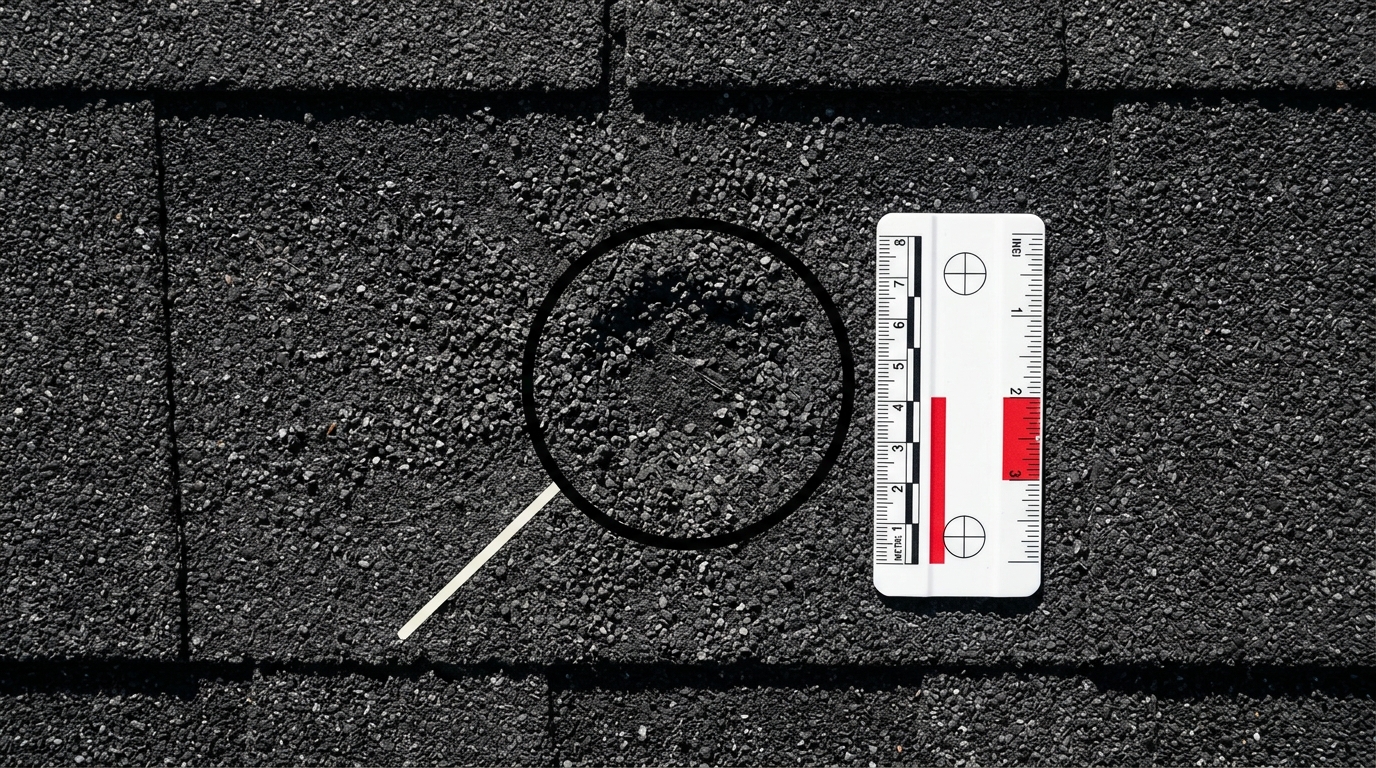
Beyond safety, the resolution advantage is significant. Ironclad's inspection drones capture imagery at resolutions tight enough to show individual granule loss on a 3-tab shingle from 30 feet. That level of detail matters when you're trying to distinguish cosmetic surface wear from impact-related bruising that qualifies for an insurance claim under a standard RCV (replacement cost value) policy.
In Middle Tennessee specifically, steep rooflines, multiple dormers, and complex hip-and-valley configurations are common on homes built throughout the Brentwood, Franklin, and Hendersonville corridors. These roof shapes create blind spots that even experienced inspectors can miss from a ladder. A drone with a gimbal-stabilized camera covers every angle in a single flight.
The Full 21-Point Checklist: What Ironclad Looks For
Each of the 21 inspection points falls into one of five structural zones. The table below maps every checkpoint to its zone, what the drone camera captures, and why that data point matters to your roof's performance or your insurance claim.
| Zone | Inspection Point | What the Camera Captures | Why It Matters |
|---|---|---|---|
| Field Shingles | 1. Granule loss pattern | Bare mat exposure, streaking, circular impact zones | Distinguishes normal aging from hail impact |
| Field Shingles | 2. Shingle cracking | Hairline fractures across tabs or laminate layers | Cracked shingles allow water infiltration within 6–18 months |
| Field Shingles | 3. Shingle lifting or cupping | Raised shingle edges casting visible shadows | Lifted shingles fail in 45+ mph wind events |
| Field Shingles | 4. Missing shingles | Exposed felt or decking, bare nail lines | Immediate water entry risk; supports emergency claim priority |
| Field Shingles | 5. Algae and moss growth | Black streaking, green biological mats | Moss lifts shingle edges; algae is cosmetic but signals moisture retention |
| Ridges and Hips | 6. Ridge cap integrity | Cracked, missing, or improperly lapped caps | Ridge caps are the first failure point in high-wind events |
| Ridges and Hips | 7. Hip shingle alignment | Staggered or misaligned hip courses | Misaligned hips create wind-driven rain entry at the seams |
| Valleys | 8. Open valley metal condition | Rust, holes, improper overlap, debris dams | Valleys channel the highest water volume on any roof plane |
| Valleys | 9. Woven or closed valley wear | Accelerated granule loss at the weave centerline | Woven valleys wear 2–3x faster than field shingles in the same storm |
| Flashings | 10. Step flashing at sidewalls | Separation, rust, improper lapping over shingles | Failed step flashing is the leading cause of interior wall leaks |
| Flashings | 11. Chimney flashing | Separated counter-flashing, cracked mortar at reglets | Chimney leaks are frequently misdiagnosed as interior condensation |
| Flashings | 12. Pipe boot condition | Cracked rubber collars, missing caps on lead boots | Pipe boots are the most common single point of failure on a 10–15 year old roof |
| Flashings | 13. Skylight flashing | Lap seal separation, rust at curb corners | Improper skylight flashing voids most manufacturer warranties |
| Flashings | 14. Drip edge at eaves and rakes | Missing sections, improper overlap direction | Absent drip edge allows water to wick under starter shingles |
| Ventilation | 15. Ridge vent continuity | Blocked baffles, crushed foam, missing sections | Blocked ridge vents cause heat and moisture buildup that degrades decking |
| Ventilation | 16. Box or turtle vent condition | Cracked caps, missing louvers, improper placement | Inadequate exhaust venting can void a GAF shingle warranty |
| Ventilation | 17. Soffit vent blockage | Visible debris, paint-over, or insulation compression at soffits | Intake-exhaust balance requires clear soffit venting; 1 sq ft of net free area per 150 sq ft of attic floor is the standard minimum |
| Structural | 18. Decking sag or deflection | Wavy roof planes, low spots between rafters | Sagging decking indicates rafter failure or prolonged moisture damage requiring structural repair before re-roofing |
| Structural | 19. Fascia and soffit condition | Rotted wood, missing sections, improper gutter attachment | Soft fascia cannot support gutter systems; replacement is required before seamless gutter installation |
| Structural | 20. Eave overhang uniformity | Inconsistent overhang depth indicating shifted decking or prior storm damage | Asymmetric overhangs signal that previous repairs used mismatched materials |
| Structural | 21. Overall slope and plane integrity | Full-roof orthomosaic image showing any twist or rack across the entire structure | Structural racking requires an engineer's assessment before insurance settlement is finalized |
How the Inspection Report Supports Your Insurance Claim
After the flight, Ironclad produces a timestamped photo report with GPS coordinates attached to each flagged finding. Insurance adjusters in Tennessee use the Xactimate estimating platform, and our reports are formatted to align with the line items adjusters look for: granule loss severity, flashing condition codes, and structural anomalies. Providing this documentation at the time of your initial claim reduces the likelihood of a low first offer or a denial based on "insufficient evidence."
For homeowners in Murfreesboro and Franklin who have filed supplemental claims after a low initial payout, drone imagery has been the deciding factor in getting adjusters back on-site for a reinspection. The photos don't argue: circular impact bruising on a shingle is visible, measurable, and dateable against the NOAA storm record for your zip code.
Ironclad offers a free drone roof inspection in Murfreesboro, Franklin, Nashville, Brentwood, and surrounding Middle Tennessee communities. There is no obligation attached to the inspection itself.
Repair vs. Replacement: How the 21 Points Drive the Recommendation
Not every flagged finding means a full replacement. Ironclad uses a scoring threshold across the five zones to generate a repair or replace recommendation. A roof that scores failures in only the flashing zone, with field shingles and structural points passing, is a strong repair candidate. A roof scoring failures across three or more zones, especially with structural deflection or widespread granule loss exceeding 30% of the field area, is a replacement candidate.
This matters because Middle Tennessee homeowners with policies written on older roofs sometimes receive ACV (actual cash value) settlements that make repair-only responses financially prudent. The inspection score gives you concrete data to present to your insurance carrier when negotiating the scope of work.
What to Expect on Inspection Day
The drone flight itself takes 20–40 minutes for a standard residential roof depending on complexity. You do not need to be home during the flight, though most homeowners prefer to be present for the post-flight walkthrough where findings are reviewed in real time on a tablet. Ironclad's inspection technicians carry Part 107 FAA certification, which is required for commercial drone operations in Tennessee airspace. The full written report is delivered within 24 hours of the flight, formatted as a PDF with annotated photo callouts.
No roof access is required from you. There are no ladders, no weight on your shingles, and no risk of additional damage during the assessment process.
Drone Roof Inspection FAQ for Middle Tennessee Homeowners
What does a drone roof inspection show that a standard visual inspection misses?
A drone inspection captures overhead orthomosaic imagery and close-up angle shots that reveal valley wear, step flashing separation, ridge cap lifting, and decking deflection that are physically inaccessible from a ladder positioned at the eave. It also documents the full roof plane in a single image, which identifies structural racking invisible from any single ground or ladder vantage point.
Is a drone roof inspection accurate enough for an insurance claim in Tennessee?
Yes. Timestamped, GPS-tagged drone photos are accepted by major insurers operating in Tennessee, including State Farm, Allstate, and Farmers. The images align with Xactimate line items and are routinely used to support supplemental claims and adjuster reinspections when an initial offer is disputed.
How much does a drone roof inspection cost in Franklin or Murfreesboro, TN?
Ironclad offers a free drone roof inspection throughout the Middle Tennessee service area, including Franklin, Murfreesboro, Nashville, Brentwood, and Hendersonville. The inspection carries no obligation to purchase repair or replacement services.
How long does a 21-point drone roof inspection take?
The drone flight takes 20–40 minutes for most residential roofs. The post-flight review with the homeowner adds approximately 15 minutes. The full written inspection report with annotated photos is delivered within 24 hours.
Can a drone inspection tell me whether I need a repair or a full roof replacement?
Yes. Ironclad's 21-point scoring system evaluates findings across five structural zones: field shingles, ridges and hips, valleys, flashings, and structural integrity. Failures concentrated in one zone typically support a targeted repair recommendation. Failures across three or more zones, combined with granule loss exceeding 30% of the field area or any structural deflection, support a full replacement recommendation backed by the inspection documentation.
