From the blog
What to Say (and Not Say) to Your Insurance Adjuster About Roof Damage
What to Say to Your Insurance Adjuster About Roof Damage (And What to Keep to Yourself)
When filing a roof insurance claim in Tennessee, the single most important rule is this: describe what happened, not what you think it means. Adjusters are trained to listen for homeowner statements that can be used to limit or deny a payout. Knowing exactly what to say, and what to avoid, is the difference between a fair settlement and a denied roof claim in Tennessee.
Before the Adjuster Arrives: Build Your Case First
The window between discovering damage and the adjuster's visit is your most valuable preparation time. Do not wait passively. Take the following steps immediately after a storm or other covered event.
- Document everything with photos and video. Walk the perimeter of your home and photograph every visible impact point: missing shingles, granule loss in gutters, damaged flashing, dented ridge caps, and any interior water staining. Timestamp matters, so use your phone's native camera to preserve EXIF data.
- Request a professional roof inspection before the adjuster visit. A GAF Master Elite contractor can produce a written damage report that identifies hail strike density, wind-lifted shingle zones, and hidden structural issues an adjuster may overlook or intentionally minimize. This report becomes your counter-documentation if the claim is disputed.
- Pull your policy and read the covered perils section. Tennessee homeowner policies typically cover wind damage, hail, and falling objects. They typically exclude wear-and-tear and pre-existing deterioration. Know which category your damage falls into before anyone asks.
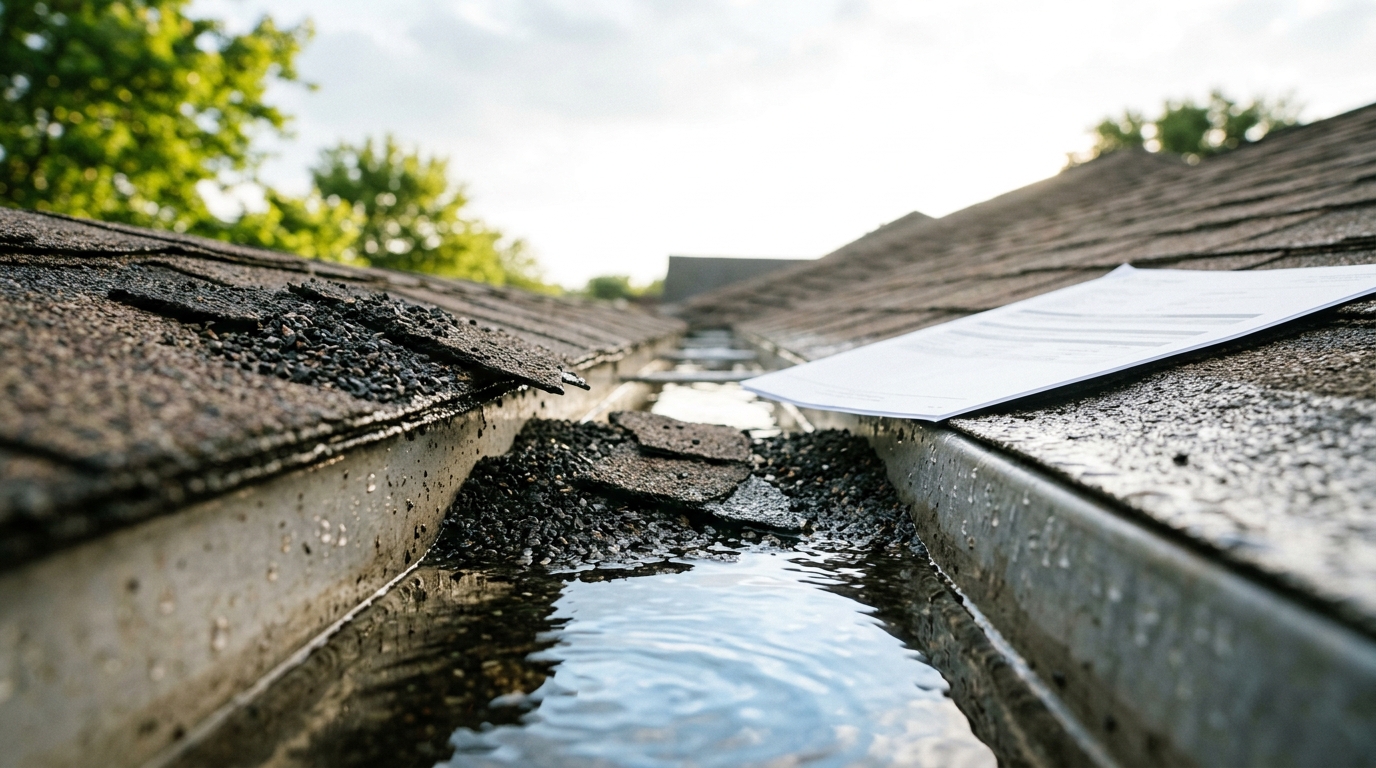
- Photograph your gutters and downspouts. Granule accumulation in gutters is direct, physical evidence of hail impact on asphalt shingles. Adjusters cannot easily dismiss it.
What to Say to the Adjuster: Stick to Observable Facts
When the adjuster arrives, your job is to be a witness, not an interpreter. Describe what you observed. Do not speculate about causes, pre-existing conditions, or repair costs.
Use this framework for every answer: date, event, observation.
- "The storm on [date] produced 70 mph wind gusts according to the National Weather Service. After the storm, I noticed shingles missing from the north slope and granules in the gutters."
- "I found this water stain on the ceiling directly below the ridge vent after last Thursday's storm. It was not there before."
- "The hail was quarter-sized, roughly one inch in diameter, and the storm lasted approximately 25 minutes."
These statements are specific, verifiable, and tied to a covered event. They give the adjuster no room to reframe your damage as a maintenance problem.
What Not to Say to the Adjuster
Certain phrases trigger automatic claim complications. Avoid these patterns entirely.
- Do not estimate the age of your own roof. Saying "the roof is probably about 15 years old" invites the adjuster to apply an Actual Cash Value (ACV) depreciation calculation rather than a Replacement Cost Value (RCV) settlement. Let the inspection documents speak to roof condition.
- Do not say the damage "might have been there before." Even a casual hedge like this is documented and can be cited as a homeowner admission that the damage predates the storm.
- Do not agree to any verbal settlement on the spot. Adjusters occasionally offer quick numbers during the inspection visit. These are almost always lower than a fully documented claim. Say: "I'd like to review the written estimate before making any decisions."
- Do not allow the adjuster to inspect alone. Walk every section of the roof with them. Point out each damage item documented in your contractor's inspection report. Damage that goes unpointed often goes unclaimed.
- Do not discuss your deductible unprompted. Your deductible is your business. Bringing it up can create confusion about whether you are trying to settle for a specific net amount.
How the Tennessee Roof Insurance Claim Process Works, Step by Step
Understanding the mechanics of the process protects you from being rushed or misled at each stage.
- File the claim promptly. Tennessee policies typically require you to report damage within a reasonable time after the event. Most carriers define "reasonable" as 30–60 days. Filing late gives the insurer grounds to deny based on lack of timely notice, especially if further weather events occur in the interim.
- Request your claim number and the adjuster's direct contact information. Every communication after this point should reference the claim number in writing.
- Obtain your own independent inspection. Schedule a drone-assisted inspection with a licensed Middle Tennessee roofing contractor before or concurrent with the adjuster's visit. Drone inspections capture imagery the adjuster cannot easily dispute and identify damage on sections of steep-pitch roofs that are unsafe to walk.
- Compare the adjuster's scope of loss to your contractor's estimate. The adjuster produces a document called a scope of loss that itemizes covered damage and assigns dollar values. Your contractor's estimate should address the same line items. Any discrepancy of more than 10–15% warrants a written rebuttal.
- Invoke the appraisal clause if the estimates diverge significantly. Tennessee homeowner policies include an appraisal clause that allows each party to hire an independent appraiser. The two appraisers then agree on an umpire. This process is faster and cheaper than litigation and frequently results in higher settlements than the insurer's initial offer.
- Understand the two-payment structure. On RCV policies, insurers issue an initial payment (ACV minus your deductible) when the claim is approved. The depreciation holdback is released after the work is completed and documented with invoices. Do not pocket the first check and skip repairs. Doing so forfeits the recoverable depreciation.
Repair vs. Replacement: How the Decision Affects Your Claim
Insurance adjusters sometimes approve repairs when a full replacement is the correct outcome. This distinction has real financial consequences for Middle Tennessee homeowners.
| Scenario | What the Adjuster May Offer | What You May Actually Need |
|---|---|---|
| Hail damage to 30% of shingles on one slope | Spot repair or slope replacement | Full roof replacement if matching shingles are discontinued |
| Wind damage with lifted but re-laid shingles | Re-seal only, no replacement | Replacement of compromised shingles with broken seals |
| Multiple storm events in one season | Partial credit toward prior claim | Separate claim or supplemental claim for cumulative damage |
| Granule loss across full surface | Cosmetic exclusion applied | Full replacement if granule loss reduces functional lifespan below insurer threshold |
Tennessee does not have a statewide matching statute as strong as some other states, but many policies include language requiring like-kind and quality materials. A GAF Master Elite installer can document when a repair-only approach fails the matching standard and support a supplemental claim.
What to Do If Your Roof Claim Is Denied in Tennessee
A denial letter is not the end of the process. It is a starting point for appeal.
First, request the full written denial with the specific policy language cited. Vague denials citing "pre-existing conditions" without itemized evidence are challengeable. Second, have your contractor provide a written rebuttal tied to the adjuster's scope of loss line by line. Third, file a complaint with the Tennessee Department of Commerce and Insurance if the denial appears to misrepresent policy terms. The department has authority to investigate bad-faith claim handling. Fourth, consult a licensed public adjuster or a policyholder attorney before agreeing to any partial settlement. Public adjusters in Tennessee work on a contingency basis, typically 10–15% of the final settlement, and routinely recover significantly more than the initial offer on disputed claims.
Roof Insurance Claim FAQ for Tennessee Homeowners
How long does a roof insurance claim take to process in Tennessee?
Most Tennessee carriers are required to acknowledge a claim within 10 days and issue a coverage decision within 15 business days of receiving all required documentation. Complex claims with supplemental damage or disputed scopes can extend to 45–90 days, particularly following large storm events that produce high claim volumes across Middle Tennessee.
Can I choose my own roofing contractor for an insurance claim repair?
Yes. You have the legal right to select any licensed Tennessee roofing contractor to complete your repairs. Your insurer cannot require you to use a preferred vendor network, though they may require the contractor to work within the approved scope of loss. If your contractor's price exceeds the insurer's estimate, the contractor can submit a supplement directly to the carrier for review.
What happens if the adjuster misses damage on my roof?
You can file a supplemental claim for damage discovered after the initial settlement. Supplemental claims are common and legitimate. Document the missed damage with photos, a written inspection report, and the contractor's line-item estimate before submitting. Insurers are required to review supplemental claims under the same standards as original claims.
Does filing a roof insurance claim raise my homeowner's insurance premium in Tennessee?
It depends on your carrier and claim history. A single weather-related claim generally has less premium impact than a liability or water-damage claim. However, multiple weather claims within a three-year period can trigger non-renewal in some markets. Discuss this with your insurance agent before filing minor claims where the repair cost is close to your deductible.
What is a public adjuster and should I hire one for a denied roof claim in Tennessee?
A public adjuster is a licensed professional who represents the policyholder, not the insurance company, in claim negotiations. They assess damage independently, prepare a counter-scope, and negotiate directly with the carrier. For denied or significantly underpaid roof claims, a public adjuster is worth consulting. They charge a percentage of the final settlement, so there is no upfront cost, and their involvement frequently results in a higher payout than the homeowner could secure negotiating alone.
