From the blog
Understanding Your Roofing Estimate: A Line-by-Line Explanation for TN Homeowners
What a Roofing Estimate Actually Covers: The Short Answer
A standard roofing estimate for a Middle Tennessee home breaks into five cost categories: materials, labor, disposal, accessories, and contractor overhead with profit margin. For an average 2,000 sq ft home in the Nashville metro, full replacement estimates in 2026 run between $9,500 and $18,000 depending on shingle grade, roof complexity, and whether decking repairs are needed. Knowing what each line item means prevents you from comparing two estimates that are not actually quoting the same scope of work.
Line 1: Roofing Materials
Materials typically represent 40–50% of your total estimate. Contractors price materials by the "square," which equals 100 square feet of roof surface. Your estimate should show the number of squares, the shingle product name and series, and a per-square cost.
In Middle Tennessee, three shingle tiers dominate residential replacements:
- 3-tab asphalt shingles: Rarely specified for new installs in 2026. Lower material cost per square, but shorter lifespan (15–20 years) and wind ratings that fall short of Tennessee's storm exposure. Some insurers now flag 3-tab roofs as high-risk.
- Architectural (dimensional) shingles: The most common choice across Nashville, Franklin, and Murfreesboro. Products like GAF Timberline HDZ carry a Class 4 impact rating and 130 mph wind resistance. Material cost runs $95–$140 per square installed.
- Premium designer shingles: GAF Camelot II and similar products mimic slate or wood shake aesthetics. Material cost reaches $200–$280 per square. Appropriate for high-value Brentwood or Franklin properties where curb appeal directly affects resale.
A legitimate estimate names the exact product, not just "architectural shingle." If the line reads "30-year architectural," ask for the manufacturer and series before signing anything.
Line 2: Labor
Labor covers tear-off of existing layers, installation of new shingles, flashing work, and ridge cap application. Labor costs in the Nashville metro currently run $70–$110 per square, reflecting the tight skilled-trades market across Middle Tennessee.
Two factors inflate labor costs that homeowners frequently overlook:
- Roof pitch: Any slope steeper than 6:12 requires safety equipment, slower installation pace, and usually a pitch premium of $15–$35 per square. A steep Victorian or craftsman-style roof in Hendersonville or Franklin can add $800–$2,000 to labor alone.
- Number of layers being removed: Tennessee building code allows up to two shingle layers on a structure. Removing two existing layers instead of one adds disposal weight and labor time. Expect a $200–$600 surcharge for double-layer tear-off.
If a contractor quotes labor suspiciously low, verify that tear-off is included. Some low-ball estimates install over existing shingles, which voids most manufacturer warranties and creates decking moisture problems within a few years.
Line 3: Decking and Structural Repairs
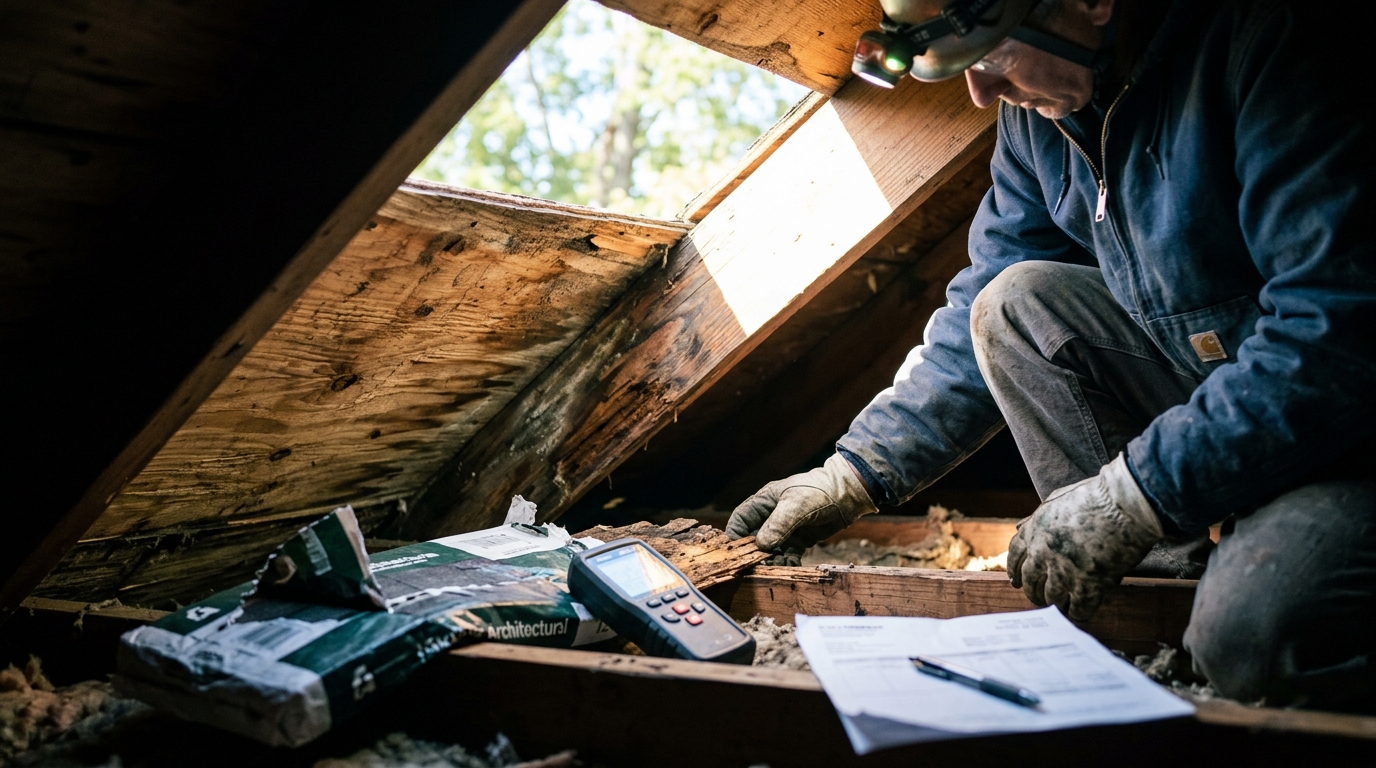
No contractor can quote decking repairs with certainty before tear-off is complete. A reputable estimate handles this one of two ways: a fixed per-sheet price for any decking replacement discovered during tear-off (typically $75–$110 per 4x8 sheet of OSB or plywood), or a stated allowance built into the contract.
Homes in Murfreesboro and older Nashville neighborhoods built before 1990 frequently show 15–30% of their decking needing replacement once shingles are removed. Budget for at least a 10% decking contingency on any home older than 20 years. Ask your contractor whether their estimate includes a decking line item or whether it will appear as a change order after tear-off, because the difference in how this is handled affects your total cost significantly.
Line 4: Accessories and System Components
This is where estimates diverge most dramatically between contractors. A complete roofing system includes components beyond shingles, and cutting corners here creates the failures that lead to premature leaks.
| Component | Purpose | Typical Cost Range |
|---|---|---|
| Synthetic underlayment | Moisture barrier between decking and shingles | $0.15–$0.25 per sq ft |
| Ice and water shield | Self-adhering membrane at valleys and eaves | $0.35–$0.55 per sq ft (applied areas) |
| Drip edge metal | Directs water into gutters, prevents fascia rot | $1.50–$2.50 per linear foot |
| Step and counter flashing | Seals roof-to-wall and chimney transitions | $200–$600 per penetration |
| Ridge vent or box vents | Attic ventilation to prevent heat and moisture buildup | $300–$700 total depending on linear footage |
| Pipe boot replacements | Rubber or metal seal around plumbing stacks | $35–$75 each |
If an estimate omits ice and water shield entirely, that is not a savings; that is a liability. Tennessee winters bring enough freeze-thaw cycles and ice damming risk in the Nashville area to make this component non-negotiable for a properly warrantied roof.
Line 5: Disposal and Permit
Debris removal and dumpster fees run $250–$500 for a typical residential job. Some contractors absorb this into overhead; others list it separately. Either approach is acceptable as long as it appears somewhere in the total. What matters is that it is accounted for, because contractors who omit it sometimes charge it as an end-of-job add-on.
Building permits for roof replacement in Davidson, Williamson, and Rutherford counties currently cost $75–$200 depending on assessed project value. Reputable contractors pull their own permits and include the fee in the estimate. Never accept an offer to skip the permit to "save money." An unpermitted roof replacement creates complications when you sell the home or file an insurance claim, and homeowner's insurance can deny storm damage claims on unpermitted work.
Line 6: Overhead and Profit Margin
A legitimate roofing contractor carries general liability insurance, workers' compensation, and maintains licensing through the Tennessee Contractor's Licensing Board. These costs are real and they are reflected in a 15–25% overhead and profit margin built into the estimate. This line is not padding; it is the difference between a company that will honor a warranty call in two years and a fly-by-night operation that disappears after storm season.
When comparing multiple estimates, a quote that comes in 25% below every competitor is almost always missing coverage, cutting material corners, or pricing labor by misclassifying workers. Ask every contractor for their certificate of insurance before the job starts.
Financing Options for Middle Tennessee Homeowners
Most reputable roofing companies in the Nashville area offer financing through third-party lenders. Common structures include 12-month same-as-cash plans, 5–10 year fixed-rate installment loans at 7–14% APR, and manufacturer-backed programs. GAF, for example, offers financing through its installer network, which is one tangible benefit of working with a GAF Master Elite contractor.
For insurance-covered replacements, the financing question is simpler: your out-of-pocket cost is your deductible, and most contractors will work directly with your adjuster. For out-of-pocket replacement, a home equity line of credit (HELOC) remains among the lower-rate options if you have sufficient equity, since interest may be tax-deductible when the project qualifies as a home improvement. Compare the contractor's offered APR against your HELOC rate before committing to in-house financing.
The ROI of a New Roof in Middle Tennessee
A new architectural shingle roof in the Nashville metro recouped approximately 56–68% of its cost in resale value according to remodeling cost-versus-value data from 2025. That figure rises meaningfully when the replacement resolves an insurance or inspection contingency that would otherwise kill a sale. In competitive submarkets like Brentwood and Franklin, a documented GAF Lifetime warranty transferred to the buyer is a measurable transaction asset. Frame roofing not as a maintenance expense but as a capital improvement that reduces negotiation leverage for buyers during inspection.
Roofing Estimate FAQ for Tennessee Homeowners
What is the average cost to replace a roof in Nashville or Franklin, TN in 2026?
For a 2,000 sq ft home with architectural shingles, full replacement in the Nashville and Franklin metro runs $11,000–$16,500 installed. Larger homes, steeper pitches, premium shingles, or significant decking damage push totals higher. Smaller, simple-slope homes can come in closer to $9,500.
How do I know if a roofing estimate is complete or missing line items?
A complete estimate names the shingle product by manufacturer and series, lists labor and tear-off separately, includes underlayment and ice-and-water shield, accounts for drip edge and flashing, and addresses disposal and permit fees. If any of these are absent, ask for a written explanation of whether they are included in another line or excluded from scope.
Can I finance a roof replacement if my insurance does not cover it?
Yes. Most Middle Tennessee roofing contractors offer third-party financing with terms from 12 months to 10 years. Compare the offered APR to your HELOC rate if applicable. Approval decisions are typically returned within 24–48 hours, and funding can be arranged before the job starts.
Will a new roof lower my homeowner's insurance premium in Tennessee?
Many carriers in Tennessee offer premium discounts of 5–20% for new roofs with qualifying impact-resistant shingles, specifically Class 4 rated products like GAF Timberline HDZ. Contact your insurer before finalizing your shingle selection, because the discount can offset a portion of the upgrade cost over a 5-year period.
What is the difference between a repair estimate and a replacement estimate, and how do I know which I need?
A repair is appropriate when damage is isolated to less than 25–30% of the roof surface and the existing shingles are fewer than 15 years old. Replacement is warranted when damage exceeds that threshold, when the roof has multiple repaired areas across its surface, or when an adjuster documents total loss. A drone inspection provides photographic documentation that clarifies scope and supports insurance claims regardless of which path you take.
