From the blog
Using Your Insurance Check to Pay for a New Roof: The Complete Process
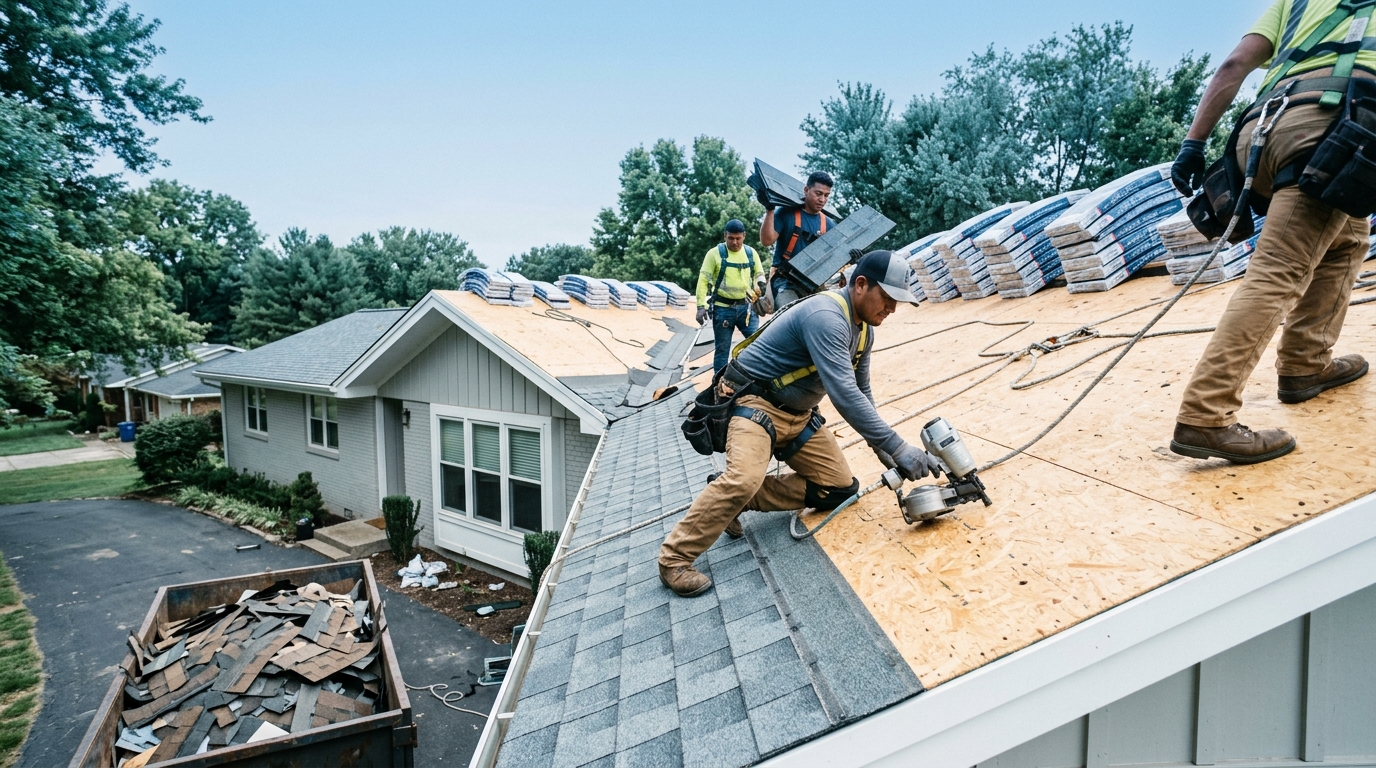
When your insurance company issues a check for roof damage, that payment covers your replacement cost minus your deductible - but the process of converting that check into a finished roof involves several steps most homeowners don't anticipate. This guide walks Middle Tennessee homeowners through every payment path available, from endorsing an insurance draft to qualifying for dedicated roof financing in Tennessee.
How Insurance Roof Payments Actually Work in Tennessee
Most homeowners insurance policies pay roof claims on one of two schedules: Actual Cash Value (ACV) or Replacement Cost Value (RCV). The distinction matters enormously for your out-of-pocket exposure.
- Actual Cash Value: The insurer pays the depreciated value of your old roof. If your 15-year-old shingles had a 25-year lifespan, you receive roughly 40% of replacement cost. You cover the rest.
- Replacement Cost Value: The insurer pays the full replacement cost in two stages. The initial check covers ACV. Once work is complete, you submit a final invoice and the insurer releases the "recoverable depreciation" as a second payment.
Understanding which policy type you carry determines how large the funding gap between your insurance proceeds and your total invoice will be. Nashville and surrounding Middle Tennessee homeowners on RCV policies typically receive 60–80% of the total roof cost upfront, with the remainder arriving after installation is verified.
The Mortgage Company Endorsement Problem
If you carry a mortgage, your insurance check almost certainly lists both your name and your lender as payees. Neither party can cash the check alone. Your lender has a legal interest in the property and uses this co-pay process to confirm repairs are actually made.
The typical lender endorsement process works like this:
- Mail or upload the check to your mortgage servicer's loss draft department.
- Submit required documents: insurance adjuster's estimate, contractor's signed contract, and sometimes proof of contractor licensing.
- The servicer endorses and returns the check, or holds funds in an escrow account and releases draws as work progresses.
- After final inspection, the servicer releases any remaining holdback funds.
This process takes 5–21 business days depending on your servicer. Plan for this delay before scheduling your crew. A reputable roofing contractor serving the Brentwood and Franklin area will understand this timeline and coordinate project start dates accordingly.
Paying the Deductible: Your Required Contribution
Tennessee law prohibits contractors from waiving, absorbing, or discounting your deductible on an insurance-funded project. Any contractor who offers to "cover your deductible" is committing insurance fraud, which puts you at legal risk as well. Your deductible is a required out-of-pocket payment, and it typically runs $1,000–$2,500 on standard homeowners policies in the Nashville metro area.
If that deductible creates a hardship, the payment options below apply directly to covering it.
Roof Financing Tennessee Options When Insurance Falls Short
Insurance rarely covers 100% of a roof replacement. Depreciation holdbacks, deductibles, and code upgrade costs (like updated decking or ventilation required by current Murfreesboro or Metro Nashville building codes) create gaps. Here are the financing paths available to Middle Tennessee homeowners.
Manufacturer-Backed Financing Programs
GAF, one of the largest shingle manufacturers in North America, offers consumer financing through certified contractor networks. GAF Master Elite contractors, who represent fewer than 3% of all roofing contractors nationwide, can offer GreenSky and similar programs with terms including:
- 18-month same-as-cash promotional periods
- Fixed-rate installment loans from 36–144 months
- Soft credit pulls for initial qualification
- Approval decisions in under 60 seconds in most cases
These programs are purpose-built for home improvement and typically have higher approval rates than personal loan applications for homeowners with credit scores in the 620–680 range.
Home Equity Financing
Homeowners who have built equity in Hendersonville, Franklin, or Brentwood properties have access to two equity-based tools:
- Home Equity Loan (HEL): A lump-sum loan at a fixed rate, secured by your home. Rates as of early 2026 run roughly 7.5–9.5% for well-qualified borrowers, depending on LTV ratio and credit profile.
- Home Equity Line of Credit (HELOC): A revolving credit line you draw against as needed. Better suited if you're combining roof replacement with other repairs after storm damage.
Interest on home equity debt used for capital improvements is often tax-deductible. Consult a licensed CPA before claiming this deduction, as thresholds apply.
Personal Loans for Roof Replacement
Unsecured personal loans require no home equity and fund in 1–3 business days through online lenders. They carry higher rates than secured products (typically 10–24% APR for borrowers with good credit) but work well for covering deductibles or depreciation gaps. For a $2,500 deductible financed over 24 months at 14% APR, monthly payments run approximately $120.
FHA Title I Property Improvement Loans
The FHA Title I program allows borrowing up to $25,000 for single-family home improvements without requiring equity. Lenders approved by HUD originate these loans, and they carry fixed rates with terms up to 20 years. This is one of the most underutilized options for how to pay for a roof with no money tied up in home equity.
Contractor Payment Plans
Some established Middle Tennessee roofing companies offer in-house payment plans for specific cost segments, most commonly the deductible amount. These are typically short-term arrangements (3–12 months, interest-free) structured as a service to existing customers rather than a financing product. Ask directly during your estimate whether a payment plan for a new roof is available for your situation.
Insurance vs. Financing: A Comparison of Roof Payment Paths
| Payment Path | Best For | Time to Fund | Typical Cost to Borrower |
|---|---|---|---|
| RCV Insurance Proceeds | Storm damage with RCV policy | 5–21 days (lender endorsement) | Deductible only (if full RCV paid) |
| ACV Insurance + Personal Loan | ACV policy holders bridging depreciation gap | 1–3 business days for loan | 10–24% APR on gap amount |
| GAF/GreenSky Financing | Homeowners needing full or partial project financing | Same-day approval | 0% promo or fixed rate 7–17% |
| Home Equity Loan | Homeowners with 20%+ equity, non-urgent timeline | 14–30 days | 7.5–9.5% APR (2026 rates) |
| FHA Title I Loan | Low-equity homeowners needing up to $25,000 | 7–21 days | Fixed rate, set by lender |
| Contractor Payment Plan | Covering deductible only | Immediate | Often 0% for short terms |
What Middle Tennessee Homeowners Should Do First
Before selecting a payment path, complete these steps in order:
- Confirm your policy type (ACV vs. RCV) by calling your insurance agent and requesting a copy of your declarations page.
- Get a professional roof inspection, ideally a drone-assisted inspection that produces a detailed photographic damage report your adjuster can reference.
- Obtain your insurance adjuster's written estimate before signing any contractor agreement.
- Select a licensed, insured contractor and confirm they will work directly with your insurance carrier to reconcile scope discrepancies.
- Identify your funding gap (adjuster estimate minus deductible, minus any depreciation holdback) and match that gap to the financing option that carries the lowest total cost.
Working with a GAF Master Elite certified contractor in Middle Tennessee protects your investment at every stage: these contractors carry the credentials insurers respect, offer manufacturer-backed financing programs, and back completed work with a lifetime workmanship warranty that standard contractors cannot offer.
Roof Insurance and Financing FAQ
Can I keep the insurance money and not replace my roof?
On an ACV policy with no mortgage, technically yes, though doing so voids future claims related to the same damage. On an RCV policy, the insurer releases recoverable depreciation only after you submit proof of completed repairs. If you carry a mortgage, your lender's loss draft agreement legally requires you to complete repairs and will hold funds in escrow until inspections confirm the work is done.
How do payment plans for a new roof affect my insurance claim?
Financing your deductible or depreciation gap through a personal loan, contractor plan, or manufacturer program has no effect on your insurance claim. These are separate transactions. Your contractor bills your insurer for the covered scope and bills you separately for any amount outside coverage. The insurer does not see or regulate how you fund your out-of-pocket portion.
What credit score do I need to qualify for roof replacement loans?
GreenSky and similar home improvement financing programs typically approve borrowers at 600 and above for standard installment products, with promotional zero-interest terms generally requiring 660 or higher. FHA Title I loans are available to borrowers with scores as low as 580 at participating lenders. Personal loan rates become competitive above 680.
How long does it take to get an insurance check after a storm in Nashville?
Tennessee's Prompt Payment Act requires insurers to acknowledge claims within 10 business days and pay or deny within 15 business days of receiving all required documentation. In practice, straightforward storm damage claims in the Nashville, Murfreesboro, and Hendersonville area are typically paid within 14–21 days of the adjuster's inspection, assuming no supplemental negotiation is needed.
Is there roof financing in Tennessee for homeowners with no equity?
Yes. Unsecured personal loans and FHA Title I Property Improvement Loans both require zero home equity. Manufacturer financing programs through GAF Master Elite contractors also use unsecured structures. Homeowners who genuinely cannot qualify for any loan product should ask their contractor about short-term in-house payment plans covering the deductible, and contact the Tennessee Housing Development Agency (THDA) about any active home repair assistance programs in their county.
